Skip to content

San Jose Water Company (SJWC)

San Jose Watering Schedule

Mandatory hours, no set daysRules verified August 25, 2026

Year-round rules, no assigned days

  • No overhead irrigation of outdoor landscapes between 9 a.m. and 6 p.m. (Valley Water Ordinance 23-02).
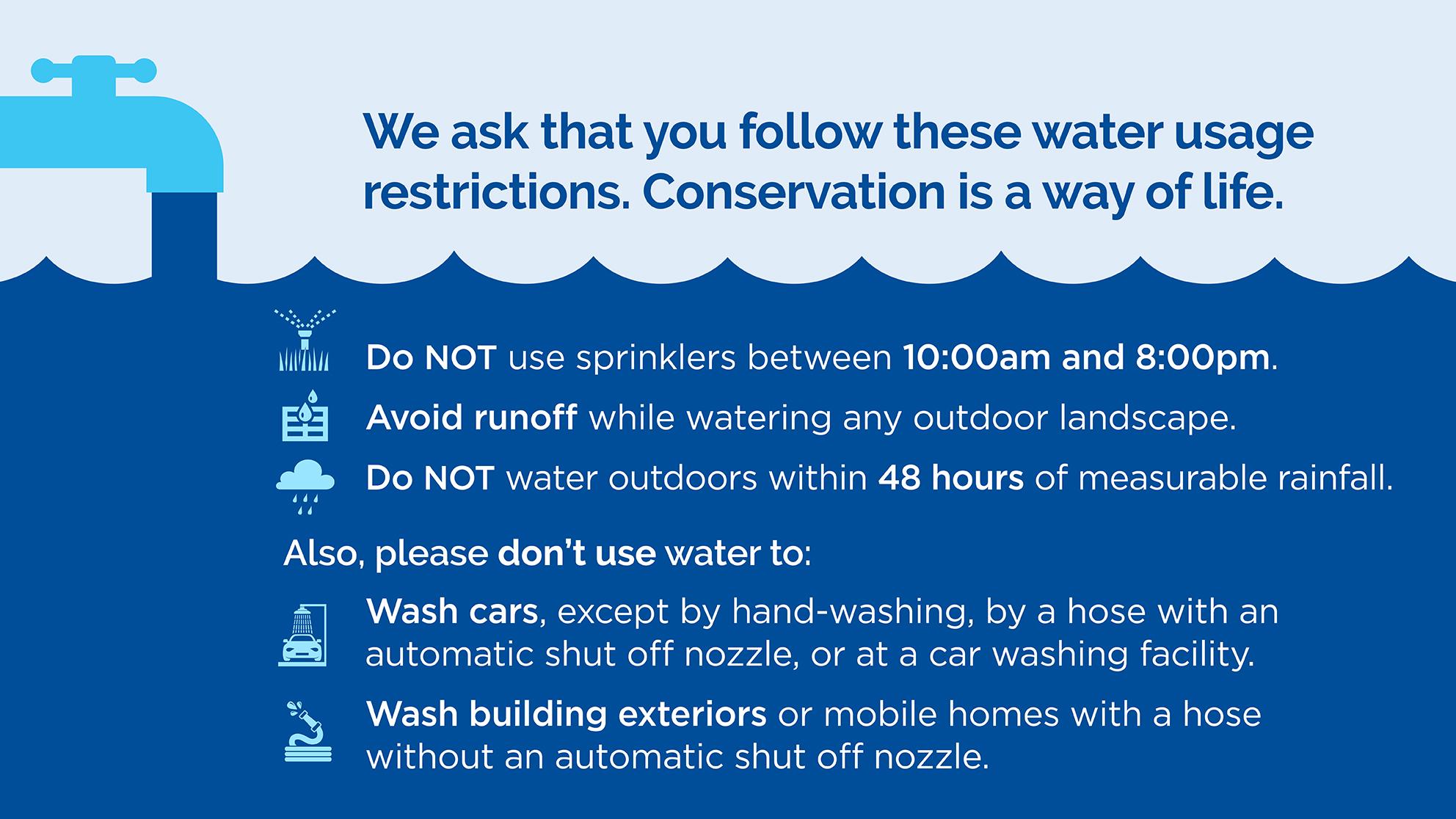
  • SJWC separately asks customers not to use sprinklers between 10 a.m. and 8 p.m.; that wording is a request, the ordinance hours are the enforceable ones.
  • No watering during or within 48 hours after measurable daily rainfall of at least 0.25 inches.
  • No watering that causes more than incidental runoff.
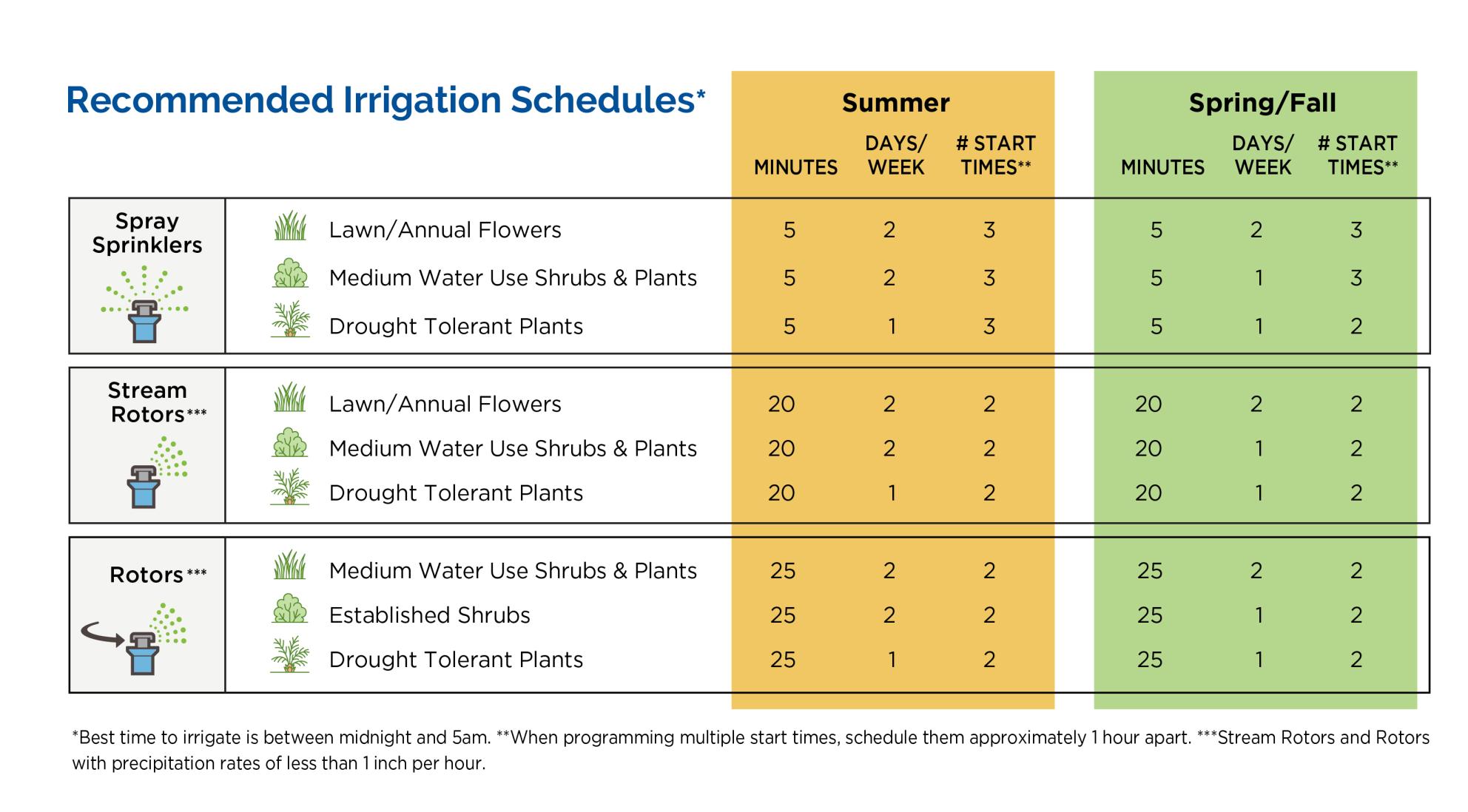
  • Recommended, not mandatory: irrigate between midnight and 5 a.m.; in summer, lawns 2 days per week and drought tolerant plants 1 day per week.

San Jose Water Company customers have no assigned watering days as of August 2026: no odd/even schedule, no set weekdays, and no days-per-week cap. What is mandatory year-round, under Valley Water Ordinance 23-02, is no overhead irrigation of outdoor landscapes between 9 a.m. and 6 p.m., no watering that causes more than incidental runoff, and no watering during or within 48 hours after measurable daily rainfall of at least 0.25 inches. SJWC separately asks customers not to use sprinklers between 10 a.m. and 8 p.m., but that is a request; the enforceable ordinance hours are 9 a.m. to 6 p.m. SJWC also publishes a recommended schedule of 1 to 2 watering days per week, best run between midnight and 5 a.m.

How many minutes on each watering day

San Jose Water Company (SJWC) assigns no watering days, so nobody can tell you how many days to split the week across. Set the days you actually water and this works out the minutes from San Jose's climate for the month you pick.

Climate data

San Jose · 43.7 in/yr

About 30 minutes per watering day, 2 days a week.

How that was worked out

Week's climate demand: 6.1 in for July × 7 ÷ 31 days = 1.377 in

Plants need: 1.377 × 0.8 = 1.102 in this week

Run time: 1.102 ÷ (1.6 in/hr × 0.7) × 60 = 59 min per week

Split: 59 ÷ 2 watering days = 30 min each time

If water runs off the edges before the cycle ends, split each day into shorter back-to-back cycles with a soak break between them. The total minutes stay the same.

Rain is not subtracted here. Skip watering during and after rain, and follow your supplier's rain rule. Point-source drip emitters and Bubblers are not in the list above: no manufacturer publishes an inches-per-hour rate for them, so those zones are watered by volume rather than by a run time against a rate.

Want the full method, the nozzle rate tables and their sources? Open the run time calculator.

Current status

No drought emergency and no mandatory water-use reduction call as of Aug 2026. Operating under permanent "Water Conservation as a Way of Life" rules: Valley Water Resolution 23-52 and Ordinance 23-02 (both adopted June 13, 2023). SJWC's own mandatory drought allocations and surcharges ended April 11, 2023.

The schedule

Year-round (mandatory conduct rules, Valley Water Ordinance 23-02)

Permanent, effective June 13, 2023 (no seasonal date ranges printed)

Days: No set watering days for residential customers. No odd/even, no assigned weekdays, no days-per-week cap. (The 2-day/week limit on non-functional turf existed only under the 2021-2022 drought ordinance, which Ordinance 23-02 explicitly replaced and rescinded.)

Hours: Ordinance 23-02 sec. 3.1(a): do not "apply potable water to any outdoor landscape between the hours of 9:00 AM and 6:00 PM through overhead irrigation." SJWC's own graphic asks customers: "Do NOT use sprinklers between 10:00am and 8:00pm" (request wording; the enforceable ordinance hours are 9 AM-6 PM). Also prohibited: watering causing more than incidental runoff; watering during and within 48 hours after measurable daily rainfall of at least 0.25 inches; applying potable water to non-functional turf at commercial/industrial/institutional sites incl. HOAs.

Run-time limits: None mandated.

Summer (SJWC "Recommended Irrigation Schedules" - advisory only)

No date range printed; labeled only "Summer"

Days: Recommended days/week by plant type: spray sprinklers - lawn/annual flowers 2, medium water use shrubs 2, drought tolerant 1; stream rotors - lawn 2, medium shrubs 2, drought tolerant 1; rotors - medium shrubs 2, established shrubs 2, drought tolerant 1

Hours: "Best time to irrigate is between midnight and 5am"; multiple start times ~1 hour apart (3 start times for spray, 2 for rotors)

Run-time limits: Per start time by nozzle: spray sprinklers 5 min; stream rotors 20 min; rotors 25 min (stream rotors/rotors = precipitation rate under 1 inch/hour)

Spring/Fall (SJWC "Recommended Irrigation Schedules" - advisory only)

No date range printed; labeled only "Spring/Fall"

Days: Recommended days/week: spray sprinklers - lawn/annual flowers 2, medium shrubs 1, drought tolerant 1; stream rotors - lawn 2, medium shrubs 1, drought tolerant 1; rotors - medium shrubs 2, established shrubs 1, drought tolerant 1

Hours: Same guidance: irrigate between midnight and 5am; start times ~1 hour apart (spray 3 starts except drought tolerant 2; rotors 2)

Run-time limits: Spray sprinklers 5 min; stream rotors 20 min; rotors 25 min per start time

Winter

Not printed

Days: No winter column appears in SJWC's recommended schedule graphic; no rule stated

Hours: Mandatory year-round rules still apply (no overhead irrigation 9 AM-6 PM, rain and runoff rules)

Run-time limits: None stated

Exceptions and standing rules

  • Ordinance 23-02 sec. 3.2 (verbatim): "The use of potable water is not prohibited to the extent necessary to ensure the health of trees and other perennial non-Turf plantings or to the extent necessary to address immediate health and safety, sanitation, or fire protection needs as determined by the fire marshal." Such watering must be done in a manner that prevents runoff unless the fire marshal permits otherwise.
  • The 9 AM-6 PM ban applies only to watering "through overhead irrigation" - drip irrigation and hand watering are not covered by the hours restriction as written.
  • The non-functional turf ban applies only to commercial, industrial and institutional (CII) sites incl. HOA/common-interest common areas; Valley Water states it "does not apply to residential lawns, school fields, sports fields, or areas regularly used for civic or community events."
  • Trees and shrubs within non-functional turf areas may be watered directly under the canopy.
  • Car washing allowed by hand-washing without a hose, with a hand-held hose equipped with an automatic shut-off nozzle, or at a commercial car wash using recycled/recirculating water.
  • Washing building exteriors/mobile homes allowed with a hose equipped with an automatic shut-off nozzle.
  • Washing sidewalks/driveways/patios/parking lots/hard surfaces allowed "in cases where health and safety are at risk"; power washing for health and safety reasons is not a violation.
  • Runoff rule tolerates "Incidental Runoff" (unintended, minimal overspray).
  • Leaking-fixture prohibition applies only after Valley Water or the retailer has notified the customer in writing to make the repair.
  • No printed exceptions for new plantings, edibles, pots, hot days, or smart controllers - the ordinance does not mention them.

Fines and enforcement

  1. CURRENT (Aug 2026): Valley Water Water Waste Enforcement page (verbatim): "There is currently no call for mandatory water use reduction; therefore, Valley Water will not be issuing fines for water waste violations." Enforcement is educational (notice of complaint + program info; after the second repeat complaint, subsequent complaints are forwarded to the water retailer). "Water retailers and/or local municipalities may issue fines or take other enforcement actions, such as installing a flow restrictor."
  2. IF a mandatory water-use reduction is called (Ordinance 23-02 secs. 5.2-5.3): Notice of Report of Violation (warning, no fine) -> Notice of Second Report of Violation (after 14+ days, within 12 months) -> Notice of Third Report of Violation (after 14+ more days) -> site visit, then Notice of Violation with administrative fine of up to $100 per violation found.
  3. Extraordinary circumstances (actual notice + intentional conduct + substantial water): fine of up to $10,000.
  4. Repeat violation continuing 31+ days after a Notice of Violation: additional fine of up to $10,000, then up to $500 for each additional day the violation continues.
  5. Appeal: written hearing request to the Clerk of the Board within 30 calendar days of a Notice of Violation; CEO or designee's decision is final.
  6. SJWC: no current drought surcharges or allocations (ended April 11, 2023); no SJWC-specific fine schedule is currently published.

Report water waste: Valley Water: Access Valley Water portal (access.valleywater.org), phone 408-630-2000, or valleywater.org/saving-water/outdoor-conservation/report-water-waste (anonymous OK; include photos, cross-streets, and landmarks (verbatim list on the Valley Water report page)). SJWC customers can also use SJWC's Report Water Waste form at sjwater.com/our-company/contact-us/report-leaks-or-water-waste/ (emergencies: 408-279-7900).

Is this your water supplier?

Parts of San Jose are NOT served by SJWC: San Jose Municipal Water System (North San Jose/Alviso, Evergreen, Edenvale/Coyote Valley) and Great Oaks Water Company (south San Jose/Santa Teresa area); adjacent cities have their own utilities (City of Santa Clara Water, Sunnyvale, Milpitas) - all are Valley Water retailers, so Ordinance 23-02 conduct rules apply county-wide, but retailer-level programs differ.

Questions people ask

Are there set watering days in San Jose?
No. As of August 2026 there are no set watering days for San Jose Water Company customers: no odd/even schedule, no assigned weekdays, and no days-per-week cap. San Jose operates under Valley Water's permanent Water Conservation as a Way of Life rules, adopted June 13, 2023, which regulate hours, runoff, and rain rather than specific days.
What hours are sprinklers allowed to run?
Valley Water Ordinance 23-02 prohibits applying potable water to any outdoor landscape between 9 a.m. and 6 p.m. through overhead irrigation, so sprinklers run before 9 a.m. or after 6 p.m. SJWC's own graphic asks customers not to use sprinklers between 10 a.m. and 8 p.m., but that is request wording; the enforceable ordinance hours are 9 a.m. to 6 p.m. For best results, SJWC's recommended schedule says the best time to irrigate is between midnight and 5 a.m.
Does the 9 a.m. to 6 p.m. ban apply to drip irrigation or hand watering?
No. The ban applies only to watering through overhead irrigation, so drip irrigation and hand watering are not covered by the hours restriction as written. The rain rule, the runoff rule, and the other year-round rules still apply.
What happens when it rains?
Watering is prohibited during and within 48 hours after measurable daily rainfall of at least 0.25 inches. This is a permanent year-round rule under Valley Water Ordinance 23-02, not a drought measure.
What watering is exempt from the rules?
Ordinance 23-02 states that potable water use is not prohibited to the extent necessary to ensure the health of trees and other perennial non-turf plantings, or to address immediate health and safety, sanitation, or fire protection needs as determined by the fire marshal, done in a way that prevents runoff. The non-functional turf ban covers only commercial, industrial, and institutional sites including HOA common areas; Valley Water states it does not apply to residential lawns, school fields, sports fields, or areas regularly used for civic or community events. Car washing is allowed by hand without a hose, with a hand-held hose equipped with an automatic shut-off nozzle, or at a commercial car wash using recycled or recirculating water.
What are the fines for water waste in San Jose?
Right now Valley Water is not issuing any. Its enforcement page states there is currently no call for mandatory water use reduction, therefore it will not be issuing fines for water waste violations; enforcement is educational, though water retailers and local municipalities may issue fines or take other actions such as installing a flow restrictor. If a mandatory reduction is called, Ordinance 23-02 sets a ladder: a warning notice, a second notice after at least 14 days (within 12 months), a third after at least 14 more days, then a site visit and an administrative fine of up to $100 per violation found. Extraordinary circumstances can bring a fine of up to $10,000, and a violation continuing 31 or more days after a Notice of Violation can add up to $10,000 more, plus up to $500 for each additional day; appeals go in writing to the Clerk of the Board within 30 calendar days.
Didn't San Jose have a two-day-per-week watering limit?
It did during the 2021-2022 drought, under an ordinance that Valley Water Ordinance 23-02 explicitly replaced and rescinded on June 13, 2023. SJWC's own mandatory drought allocations and surcharges ended April 11, 2023. Sites still claiming a mandatory twice-weekly San Jose schedule for 2026 are contradicted by the suppliers' own current pages.
My address is in San Jose but SJWC is not my supplier. Whose rules apply?
Parts of San Jose are not served by SJWC: the San Jose Municipal Water System serves North San Jose/Alviso, Evergreen, and Edenvale/Coyote Valley, and Great Oaks Water Company serves the south San Jose/Santa Teresa area. All are Valley Water retailers, so the Ordinance 23-02 conduct rules apply county-wide, but retailer-level programs differ. Check the supplier named on your water bill.
How do I report water waste in San Jose?
Use the Access Valley Water portal at access.valleywater.org, call 408-630-2000, or use the report form on valleywater.org; anonymous reports are accepted, and Valley Water asks for photos, cross-streets, and landmarks. SJWC customers can also use SJWC's Report Water Waste form at sjwater.com, and for emergencies call 408-279-7900.
Sources

WateringTimes is an informational gardening and landscape reference for California. Watering numbers are estimates computed from public state data. Nothing on this site is regulatory or professional advice of any kind. Check your water supplier’s current rules before relying on any schedule.